
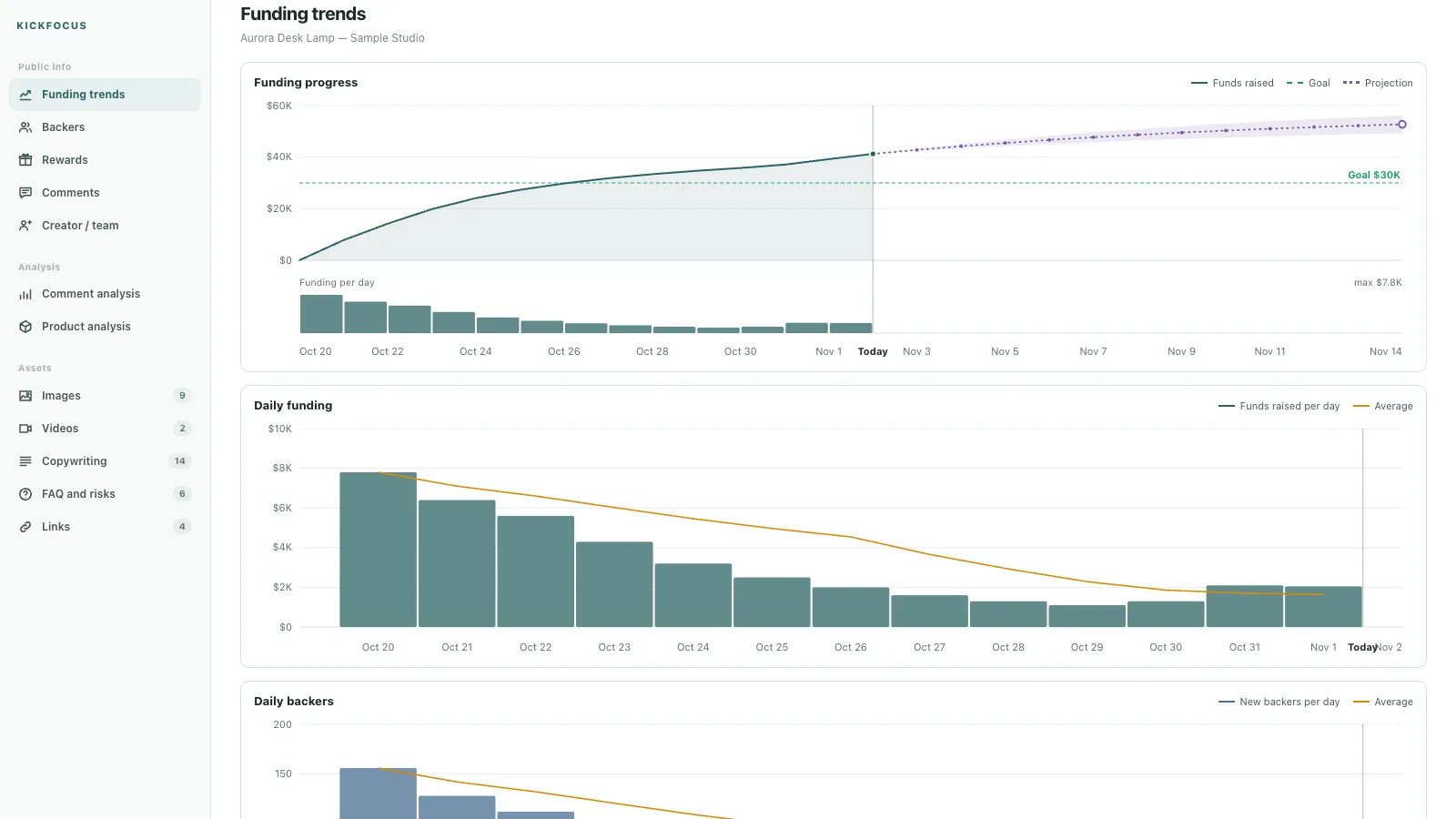

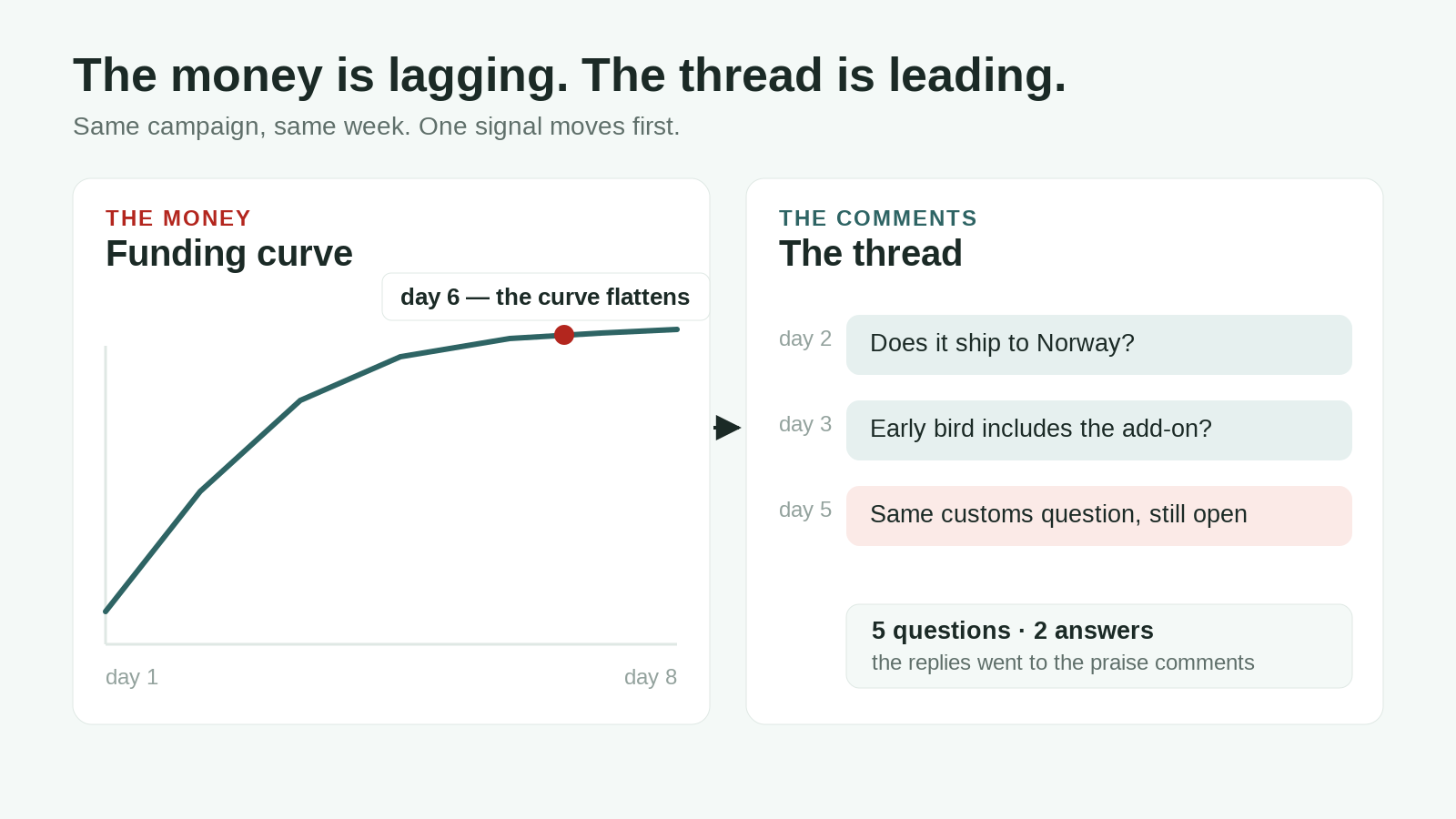
A Kickstarter comments thread is the only part of a campaign page that tells you what backers are still unsure about. The money tells you what they already did. The thread tells you what they are about to decide, which is why we read it before the curve.
Every tool shows you the money: a bar, a percentage, a projection line. The problem with the money is that it is a lagging indicator. By the time the curve tells you something is wrong, the campaign has been telling backers the same thing for a week.
The comments are a leading indicator, and they are the part nobody wants to read, because reading four hundred of them properly takes an afternoon, and three will contradict each other about whether the product ships in March.
What is actually in a Kickstarter comments thread
After a few hundred threads a pattern appears that no dashboard shows. The same question gets asked nine times and the creator answers it twice. Someone asks about shipping to Norway and gets a guess. Someone asks whether the early-bird tier includes the add-on and never gets an answer at all. That unanswered question usually appears again in the next campaign, and the one after.
A funding curve can tell you a campaign is slowing down. It cannot tell you it is slowing down because a third of the backers are waiting on an answer about customs.
How to read a thread in two minutes
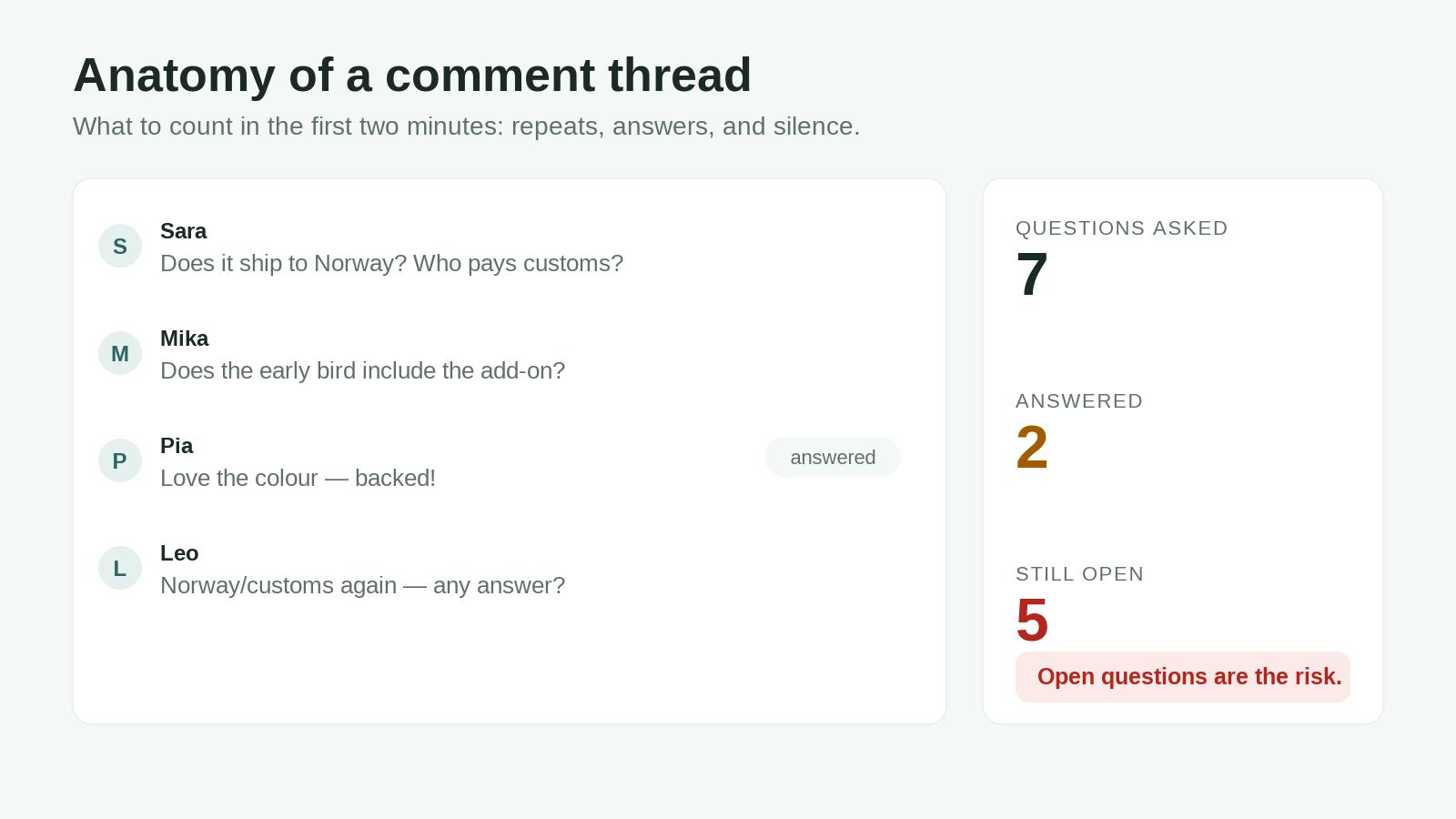
You do not need a tool to do the first pass. Open the comments, sort by newest, and read for four things:
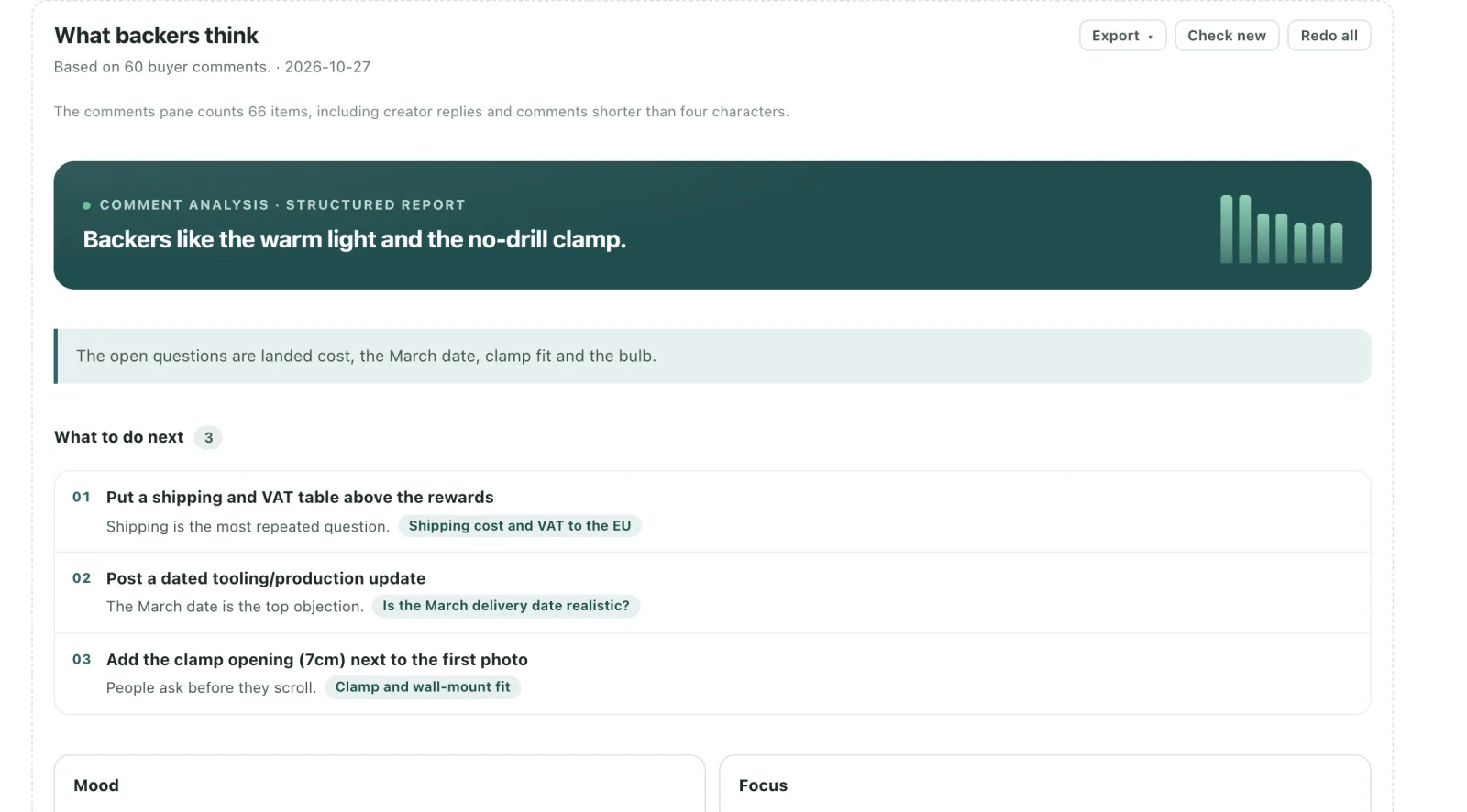
- Repeated questions. If the same concern appears five times, it is the campaign's real risk, not the one in the FAQ.
- Unanswered questions. A thread where the creator replies to praise and skips shipping is a thread that will still be unanswered after the campaign closes.
- Specific numbers. A reply that says "around March" is not the same as one that names a port, a factory and a month.
- Who is asking. A first-time backer asking about delivery is a different signal from a serial backer asking about tooling.
That pass takes two minutes and survives the next funding update. It is also the method we wrote into how to read a campaign.
Why it runs in your browser
This is the constraint that shaped the product, so it is worth stating plainly: the full comment thread is only reachable from the campaign page, with a session. There is no public endpoint that returns every comment. So the reading happens where you already are, in your browser, on the page you have open, and what leaves it is de-identified text that you asked to be analysed.
That is not a privacy feature bolted onto a server-side pipeline. It is why the pipeline looks the way it does. A cheaper architecture would have been to fetch the comments on our servers; it was not available, so we did the harder one.
What we chose not to build first
Everyone starts with a forecast. We did not, because a forecast of a campaign you can already read is mostly a restatement of the campaign. It looks like analysis because it has a line on it.
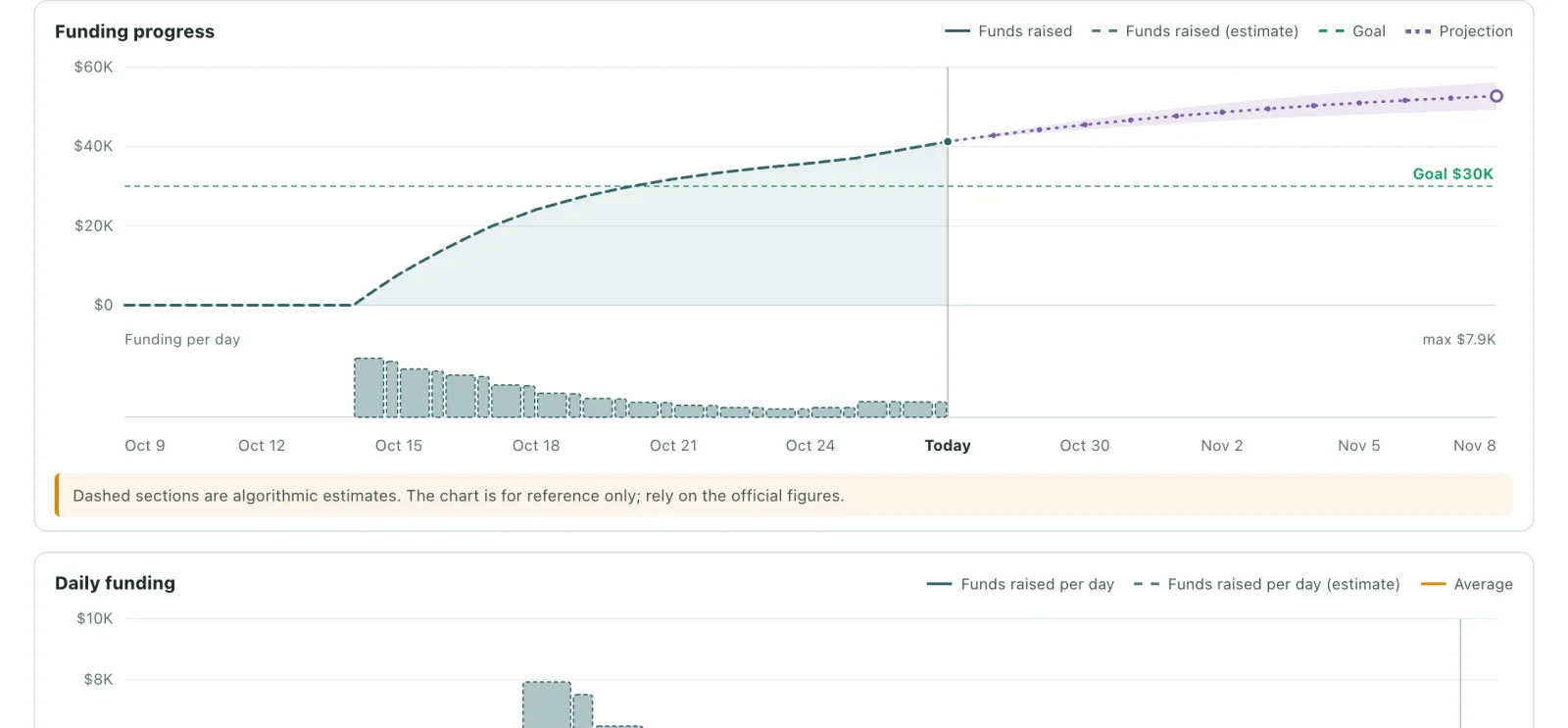
The forecast is now in the panel, built from daily snapshots rather than a formula. But it is the fourth thing, not the first. The first three are what the comments say, what the page fails to say, and what the tier structure is actually doing. If you want the long version of that argument, it is in how to set a funding goal and in the extension comparison.
What this cannot tell you
Whether the product is good, and whether anyone will fund it. An analysis reads the page the creator wrote and the comments backers left. It has no access to the factory, the margin, or the reason the last campaign slipped by four months. Those are judgement calls, and judgement is the part that does not come in a panel.
The full list of what we read, what we keep and what we are guessing at is on the methodology page. If this post and that page ever disagree, the page is right.